 How her husband’s quick action and the care provided by Alexander County EMS and other first responders helped Patsy survive cardiac arrest
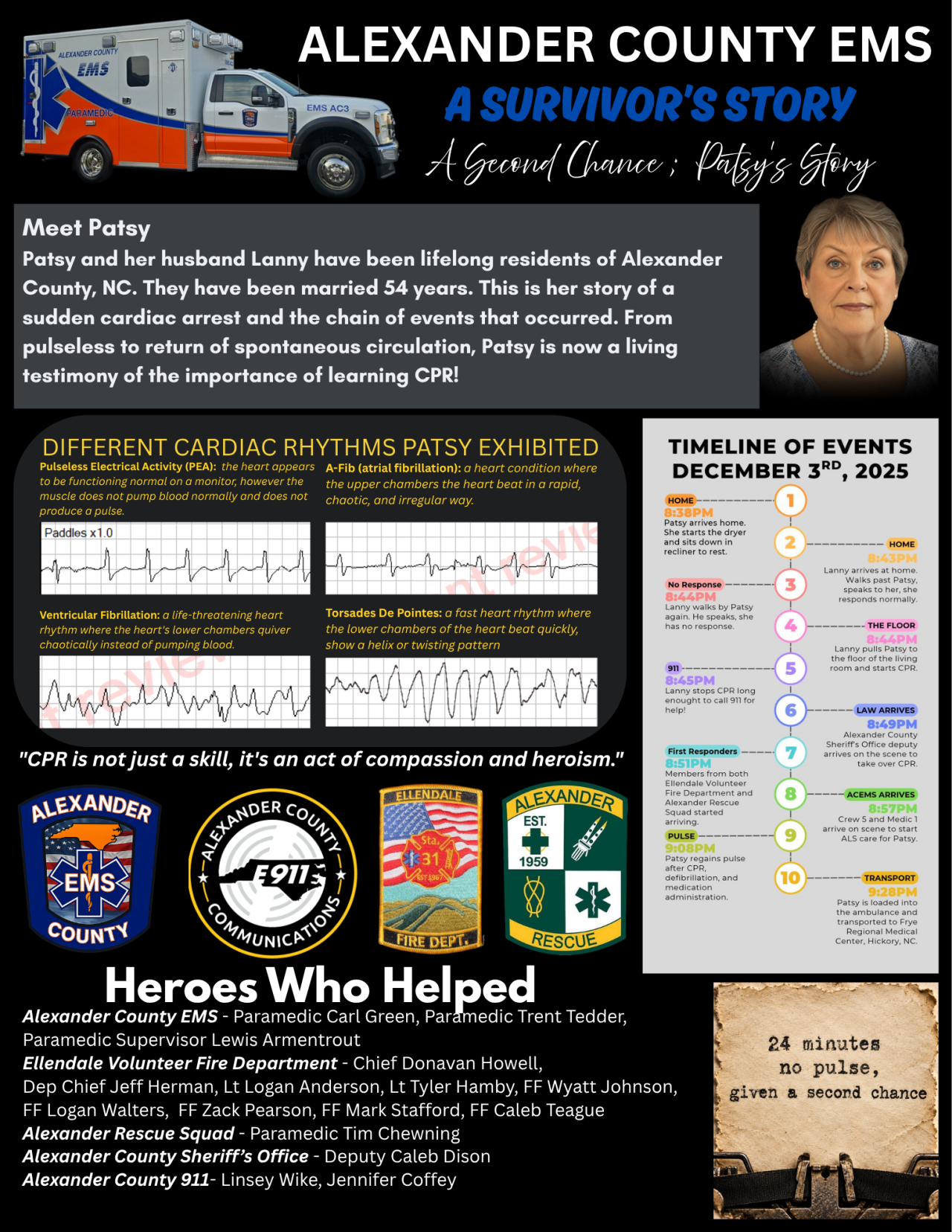
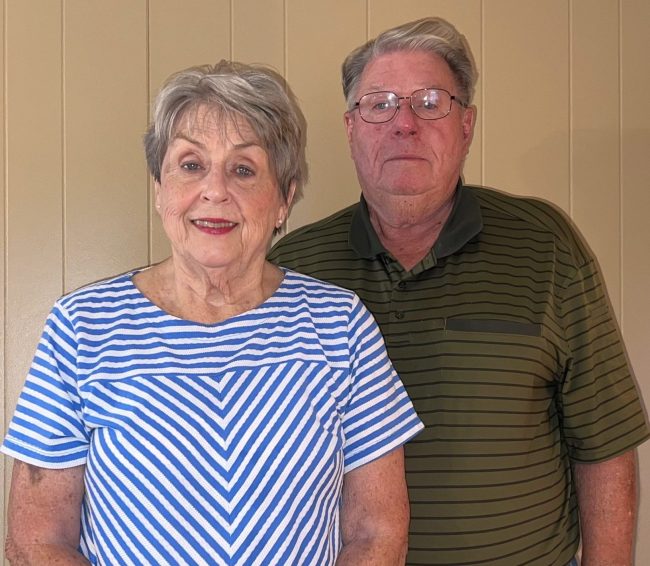
This Thanksgiving, Patsy and Lanny Stewart are grateful for another year together. Last December, an ordinary Wednesday evening took a frightening turn when Patsy went into cardiac arrest. Lanny began cardiopulmonary resuscitation (CPR) on their living room floor and kept going until help arrived. After seven days in the hospital, Patsy was back home with Lanny.
Wednesday, December 3, 2025, began like any other day for the Stewarts. It was a cool, brisk day, with temperatures reaching 49 degrees and a slight breeze in the air.
After a long day, they went to church as they usually did on Wednesday nights. Patsy left home around 5:35 p.m. for a meeting at church, leaving Lanny at home. He followed a little later, leaving at approximately 6:48 p.m. After church, she headed straight home, while Lanny stayed a few extra minutes to talk with people.
Patsy arrived home at approximately 8:38 p.m. She went inside and started the dryer to finish the laundry she had begun earlier that evening. She then went into the living room and settled into her normal spot, her comfortable recliner. She turned on the television to wind down after a long day.
Five minutes later, Lanny arrived home and said hello as he walked through the house. When he came back into the living room less than a minute later and spoke to her again, she didn’t answer.
Lanny looked at Patsy and immediately knew something was wrong. He later described what he saw as “a blank stare, nothing there.” Then, suddenly, Patsy slumped over. She was no longer breathing normally.
Lanny had worked as an EMT earlier in life. He moved Patsy from the recliner to the floor and began CPR. He called 911, set his phone on the end table, and continued CPR, giving compressions and rescue breaths while answering the dispatcher’s questions.
Patsy was occasionally gasping, a response known as agonal breathing. Lanny continued providing rescue breaths and chest compressions, doing everything he could to keep blood and oxygen circulating through her body.
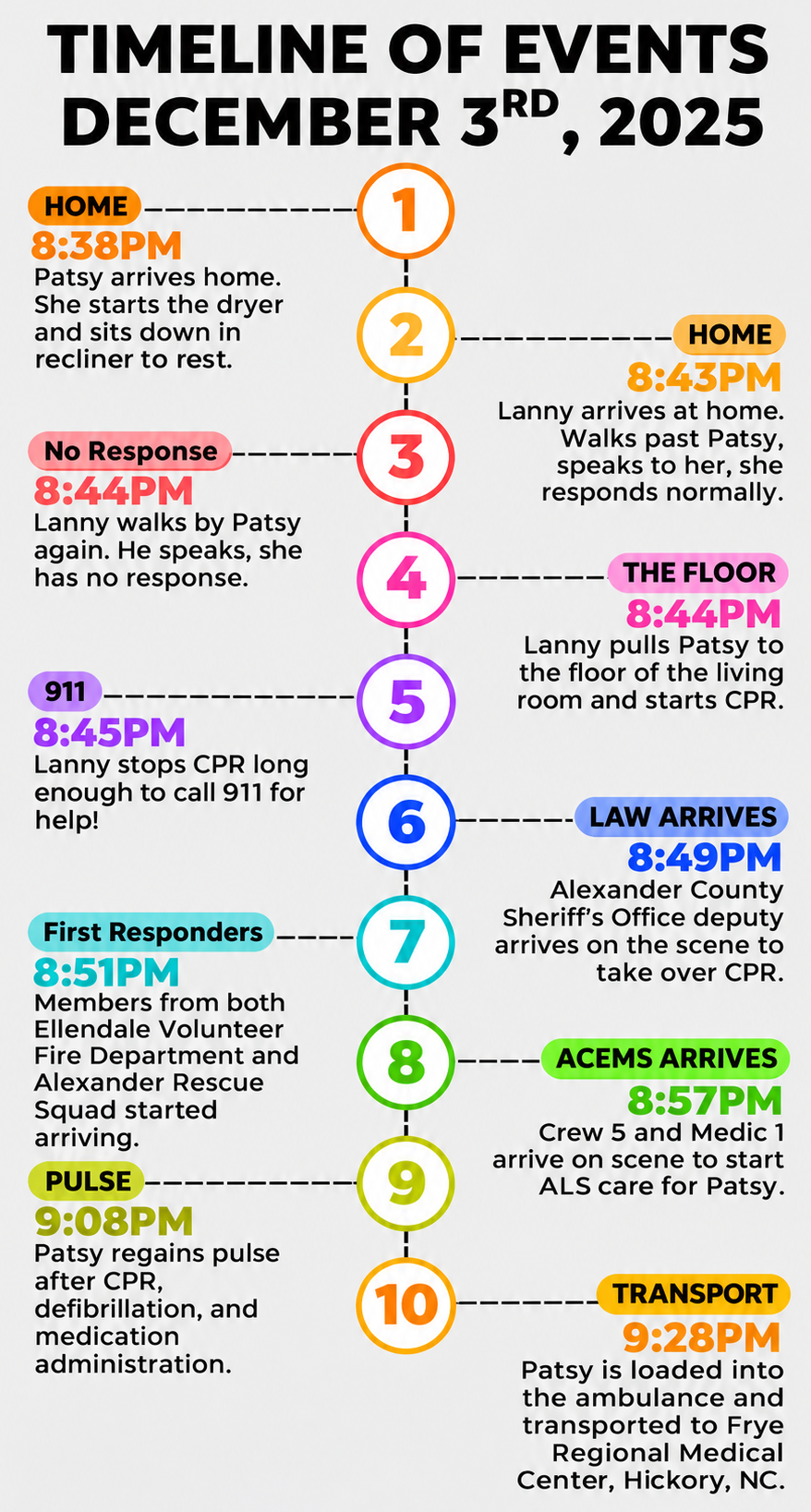 For Lanny, it must have seemed like an eternity before help arrived. In reality, it was only about four minutes after the 911 call was placed.
At 8:49 p.m., Alexander County Sheriff’s Deputy Caleb Dison was the first responder to arrive on the scene. He entered the residence and immediately took over CPR from Lanny, allowing Lanny to step back after doing everything he could to keep Patsy alive.
At 8:51 p.m., the first member of the Ellendale Volunteer Fire Department arrived to assist.
An automated external defibrillator (AED) was placed on Patsy. The device immediately indicated that she was in a shockable cardiac rhythm. Responders administered a shock and immediately resumed CPR.
At 8:57 p.m., Alexander County EMS arrived on the scene. Because of the home’s remote location and its distance from Alexander County EMS Station 1, both the ambulance and the EMS supervisor responded. Advanced life support care began immediately.
While EMS personnel prepared the necessary equipment and supplies, an Ellendale firefighter placed an i-gel airway device to assist with rescue breathing. Patsy still had no pulse, and CPR continued. EMS personnel placed Patsy on the cardiac monitor and established intraosseous access in her left lower leg, giving them a way to administer medication through the bone.
Over the next several minutes, the crew administered three medications, monitored Patsy through three different heart rhythms, and delivered two more shocks.
Then, at 9:08 p.m., something remarkable happened. Patsy regained her own heartbeat.
The crew spent about 10 minutes stabilizing Patsy before moving her to the stretcher. During that time, EMS personnel replaced the i-gel with an endotracheal tube to secure her airway, gave her medication for pain, and closely monitored her condition. They then carefully moved Patsy from the living room floor onto the stretcher and took her outside to the waiting ambulance.
EMS personnel continued caring for Patsy during the 21-minute trip to Frye Regional Medical Center. When she arrived, the hospital staff took over her treatment.
Patsy spent the night in the emergency department, and the following day, she underwent a cardiac catheterization. Doctors discovered two new areas of blockage, along with three areas that had become blocked again after previous treatment. Doctors placed five new stents during the procedure. Patsy remained in the hospital for seven days before finally being released to return home with her husband.
But perhaps the most remarkable part of Patsy’s story came next.
She had no lasting effects from the cardiac arrest. She received several physical therapy sessions and gradually regained her full strength. Today, Patsy is as vibrant and active as she was before that life-changing night.
Looking back, Patsy can even find some humor in what happened. She jokes about Lanny putting a camera in the living room pointed directly at her recliner after they returned home. This way, he can keep an eye on her whenever he is away from the house.
But beneath the humor is something much deeper. Gratitude.
Patsy is grateful to be alive. Grateful for another day. Grateful for more time to cherish with her husband and family.
December 3, 2025, started as an ordinary Wednesday. It ended with Patsy receiving something no one expected — a second chance at life. And that second chance was made possible because someone knew what to do.
Lanny started CPR. He didn’t wait. He didn’t freeze. He acted.
The 911 dispatcher, the deputy, members of the Ellendale Volunteer Fire Department and Alexander Rescue Squad, Alexander County EMS personnel, and the team at Frye Regional Medical Center all played a part in saving Patsy’s life. It all started with Lanny performing CPR.
Patsy and Lanny have agreed to share their story in hopes that it might help save someone else’s life. Their message is simple and powerful. CPR saves lives.
Alexander County EMS offers free CPR classes in February each year and encourages residents to take a class. What you learn could help you save a life.